
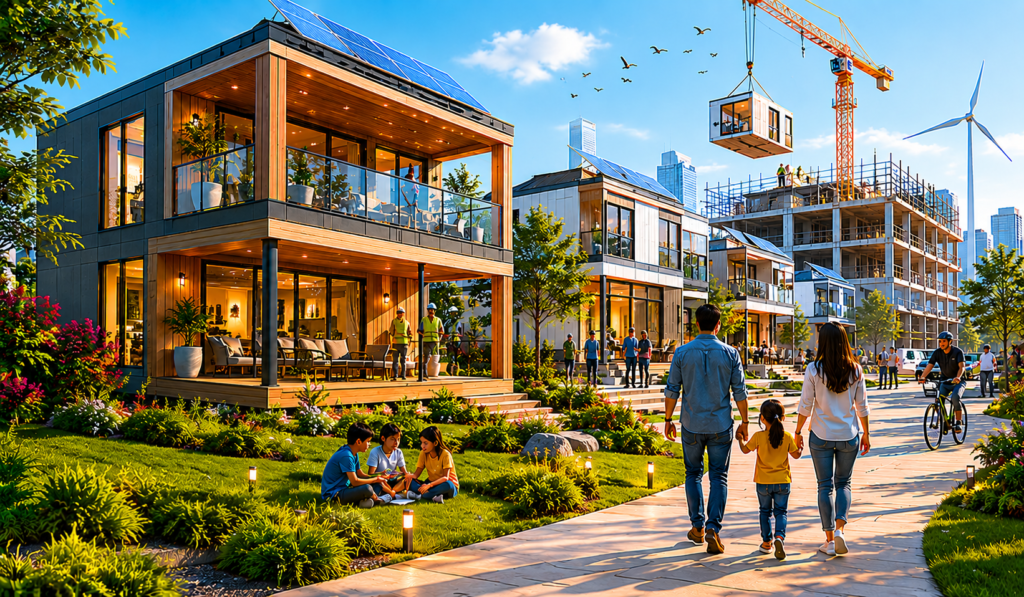
Introduction: The Affordable Housing Crisis Is Reaching a Breaking Point
Affordable housing has become one of the greatest global challenges of the 21st century. Across the United States and around the world, millions of families struggle daily with rising rents, home shortages, inflation, overcrowding, and unsafe living conditions. Governments are overwhelmed. Developers face increasing construction costs. Communities are experiencing growing displacement and homelessness.
According to the United Nations, more than 1.6 billion people globally lack adequate housing, and the number continues to rise due to:
Key Causes of the Housing Crisis
- Population growth
- Urban migration
- Natural disasters
- Economic inequality
- Rising construction costs
- Climate change
Traditional building methods simply cannot keep pace with the demand.
Nano Living Systems LLC (NLS) was created to solve this problem at scale. Through advanced modular construction, Structural Insulated Panels (SIPs), sustainable materials, and intelligent design systems, Nano is transforming affordable housing into something faster, stronger, greener, and more financially accessible.
This is not simply affordable housing. This is the reinvention of how humanity builds communities.
Why Traditional Affordable Housing Models Are Failing
For decades, affordable housing development has suffered from major limitations:
| Traditional Housing Challenges | Impact |
|---|---|
| Rising labor costs | Expensive projects |
| Slow construction timelines | Delayed occupancy |
| Material shortages | Budget overruns |
| Low energy efficiency | High utility bills |
| Poor durability | Expensive maintenance |
| Outdated designs | Reduced quality of life |
The result is housing that often becomes:
- Financially unsustainable
- Socially stigmatized
- Environmentally inefficient
- Structurally inferior
Many affordable housing projects deteriorate rapidly within years due to poor planning and low-quality materials.
Nano Living Systems was designed to break this cycle completely.
The Nano Living Systems Difference
Nano combines:
- Modular construction
- Smart home integration
- SIP technology
- Sustainable systems
- Offsite manufacturing
- Human-centered design
to create affordable housing that competes with premium residential developments in both performance and aesthetics.
Nano Homes Are:
- Faster to build
- Less expensive to operate
- More durable
- More sustainable
- More adaptable
- More beautiful
Most importantly, they restore dignity to affordable housing.
How Nano Reduces Construction Costs Without Sacrificing Quality
One of the greatest misconceptions in affordable housing is that low cost must equal low quality.
Nano disproves this entirely.
1. Offsite Manufacturing Efficiency
Traditional construction loses enormous amounts of money through:
- Weather delays
- Labor inefficiencies
- Material theft
- Scheduling conflicts
- Rework and errors
Nano’s factory-based modular manufacturing eliminates these issues.
Benefits Include
- Precision engineering
- Controlled production environments
- Reduced labor costs
- Faster build cycles
- Minimal waste
This creates major savings while increasing overall quality.
2. Structural Insulated Panels (SIPs)
Nano homes use high-performance SIP systems instead of traditional framing.
Advantages
- Energy efficiency
- Structural strength
- Indoor comfort
- Long-term durability
3. Reduced Construction Timelines
Time equals money in housing development.
Traditional multifamily projects may require:
- 12–24 months or longer
Nano projects can often reduce timelines by:
- 30–60%
This accelerates:
- Occupancy
- Rental revenue
- Investor ROI
- Community recovery
Affordable Housing That Looks and Feels Premium
Many affordable housing developments feel institutional, repetitive, and uninspiring.
Nano believes affordable housing should elevate quality of life—not diminish it.
Design Philosophy
Nano communities prioritize:
- Natural light
- Open layouts
- Green space
- Smart technology
- Modern aesthetics
- Multi-functional interiors
The result is housing residents are proud to call home.
Energy Efficiency Creates Long-Term Affordability
Affordable housing is not truly affordable if residents face:
- Massive utility bills
- Constant repairs
- Poor indoor comfort
Nano homes are designed to minimize operational expenses for decades.
Energy-Saving Features Include
- High-R-value SIP insulation
- Smart thermostats
- Solar-ready infrastructure
- LED lighting systems
- Energy-efficient HVAC
- Airtight building envelopes
Average Savings
Nano homeowners and residents can experience:
- 30–60% lower utility costs
For low-income families, this financial relief is life-changing.
Disaster Resilience Protects Vulnerable Communities
Low-income communities are often the hardest hit during natural disasters.
Nano structures are engineered for resilience.
Protection Against
- Hurricanes
- Flooding
- Wildfires
- Extreme heat
- Freezing temperatures
- Seismic activity
Structural Benefits
| Performance Feature | Nano Advantage |
|---|---|
| Wind resistance | Up to 200 mph |
| Fire resistance | Class A rated |
| Thermal efficiency | Extreme insulation |
| Mold resistance | Moisture-controlled systems |
| Lifespan | Decades longer than conventional builds |
This dramatically reduces future repair and insurance costs.
Case Study: Affordable Housing Development in Arizona
Project Overview
A nonprofit developer partnered with Nano Living Systems to create:
- 84 affordable modular housing units
- Community gardens
- Shared solar infrastructure
- Smart mobility integration
Project Goals
- Lower construction costs
- Accelerate occupancy
- Reduce resident utility expenses
- Improve long-term community stability
Nano’s Solution
Deployment Timeline
- Site preparation and manufacturing occurred simultaneously
- Entire project completed in under 7 months
Integrated Features
- SIP modular homes
- Smart climate controls
- Solar-ready rooftops
- Rainwater harvesting
- Community microgrid systems
Results
| Category | Traditional Estimate | Nano Outcome |
|---|---|---|
| Construction Timeline | 14 months | 7 months |
| Utility Costs | Standard | 45% lower |
| Waste Generated | High | Minimal |
| Occupancy Speed | Delayed | Immediate demand |
| Resident Satisfaction | Moderate | Extremely high |
The project became a regional model for sustainable affordable housing.
Traditional vs Nano Housing Timeline
Comparison of construction timelines between traditional housing projects and Nano Living Systems modular housing.0481216Traditional HousingNano Housing
Smart Technology Enhances Resident Quality of Life
Nano homes integrate modern smart-home technology traditionally unavailable in affordable housing.
Smart Features Include
- App-controlled thermostats
- Smart lighting
- Water monitoring systems
- Energy dashboards
- Voice assistant compatibility
- Predictive maintenance alerts
These systems:
- Lower costs
- Increase convenience
- Improve safety
- Support sustainability goals
Scalability: From Single Homes to Entire Cities
Nano systems are designed for scalability.
Applications Include
- Multifamily housing
- Workforce housing
- Veteran housing
- Student housing
- Transitional housing
- Refugee communities
- Senior living developments
Entire modular communities can be rapidly deployed while maintaining architectural quality and environmental performance.
The Environmental Impact of Smarter Housing
Construction is one of the world’s largest contributors to carbon emissions.
Nano dramatically reduces environmental impact through:
- Offsite precision manufacturing
- Reduced transportation waste
- Lower energy consumption
- Sustainable materials
- Renewable energy integration
Circular Economy Potential
Nano modules can also be:
- Reconfigured
- Expanded
- Relocated
- Reused
This extends building lifecycles while minimizing landfill waste.
Why Investors and Governments Are Paying Attention
Affordable housing demand continues to surge globally.
Nano offers:
- Faster ROI
- Lower operating costs
- ESG alignment
- Government incentive compatibility
- Climate resilience
- Scalable deployment
This makes Nano Living Systems highly attractive to:
- Municipalities
- NGOs
- Developers
- Institutional investors
- Public-private partnerships
The Future of Affordable Housing
The next generation of housing must be:
- Faster
- Smarter
- More sustainable
- More resilient
- More dignified
Nano Living Systems is already building that future today.
Future Nano Communities May Include
- AI-driven energy systems
- Autonomous transportation integration
- Vertical farming
- Community microgrids
- Carbon-negative materials
- Smart city connectivity
Conclusion: Building Housing That Truly Changes Lives
Affordable housing should never feel temporary, unsafe, or uninspiring.
People deserve homes that:
- Protect them
- Empower them
- Reduce financial stress
- Support healthier lifestyles
- Build stronger communities
Nano Living Systems is proving that affordability and innovation can coexist beautifully.
By combining modular speed, SIP performance, smart technology, and sustainable design, Nano is revolutionizing affordable housing worldwide—and creating a scalable solution for one of humanity’s greatest challenges.