
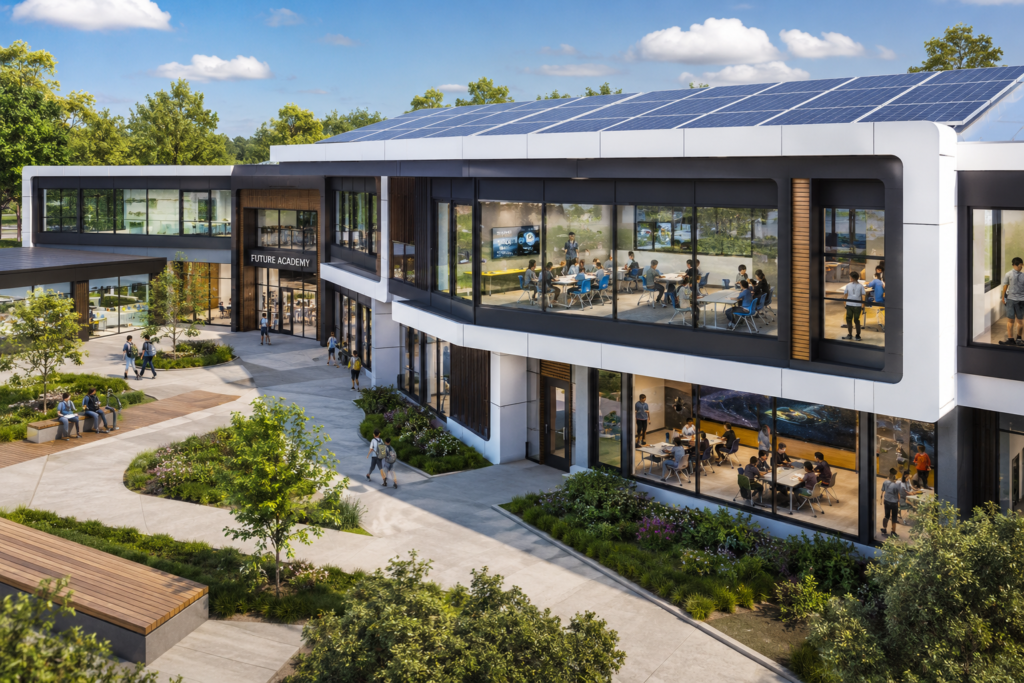
Introduction: Rethinking Educational Spaces
Traditional school construction is slow, costly, and often creates major disruption to learning. As enrollment rates fluctuate and sustainability becomes paramount, educators and institutions need solutions that are flexible, efficient, and future-proof.
Nano Living Systems (NLS) offers precisely this: modular educational facilities designed with cutting-edge SIP construction, smart integration, and modular flexibility. These schools are more than classrooms—they are innovation hubs built with speed, precision, and sustainability at their core.
Let’s explore how NLS is redefining school buildings for the 21st century.
1. Accelerated Timelines Meet Uninterrupted Education
One of the greatest struggles for schools is handling construction without hindering teaching—and modular construction is a game-changer.
Faster Construction Timelines
● Modular schools can be built up to 50% faster than traditional methods by fabricating components off-site while preparing the school’s site in parallel.
● For instance, the North Andover Early Childhood Center in Massachusetts completed its new modular facility in just six months.
Reduced Disruption During Construction
● Modular builds significantly reduce on-site work, noise, and disruptions, meaning students can continue learning throughout development.
2. Cost-Efficiency Without Compromise
Budget-conscious educators need ROI—and modular schools deliver.
Affordable Infrastructure Solutions
● These facilities consistently save up to 20% compared to traditional construction, thanks to factory economies of scale and reduced waste.
Better Budget Planning
● Predictable, transparent cost structures help districts better allocate funding—prioritizing educational outcomes rather than infrastructure delays.
3. Built to Adapt: Flexibility & Scalability
School needs change—and space must evolve with them.
Flexible Modular Design
● NLS modular designs allow easy expansion, reconfiguration, or downsizing, suiting shifting enrollment or curriculum demands.
Reusable & Repurposable Structures
● These modular facilities can be reused or repurposed, helping districts manage long-term infrastructure and community needs more sustainably.
4. Sustainability & Reduced Environmental Impact
In an age of climate urgency, modular schools are green by design.
Waste Reduction & Sustainable Materials
● Factory-based construction minimizes waste, often producing only a fraction of the byproducts generated by onsite builds.
● Incorporating sustainable materials and high-efficiency SIPs improves energy profiles and reduces lifecycle emissions.
Energy-Efficient Learning Spaces
● Modular schools can meet or exceed net-zero energy goals, demonstrating real carbon and cost savings.
5. Safety, Durability, & Quality Control
Student safety and long-term durability are non-negotiable priorities.
Factory-Controlled Precision
● Factory-controlled environments ensure precision quality and consistent compliance with codes.
Durable Construction Standards
● Robust materials and modular engineering provide longevity—even in harsh weather or high-usage scenarios.
Safer On-Site Assembly
● With pre-installed MEP, HVAC, and finishing elements, final assembly is swift—reducing site-related hazards.
6. Real-World Model: A Componentized School Built in 90 Days
Project Frog (now BuildMedia) showcases what’s possible with modular education design:
High-Speed School Construction Example
● Designed and assembled a 19,000 sq ft school in under three months.
Manufacturing Precision & Replicability
● Used interchangeable components—built with manufacturing precision—for cost efficiency and replicability.
Integrated Modular Systems
● Integrated systems (lighting, heating, structure) as unified modules—reducing complexity while elevating performance.
7. Tech Integration: The Smart School Frontier
NLS modular schools aren’t just efficient—they’re also smart.
Smart Energy Management
● IoT and data infrastructure can save up to 20% in energy use in educational buildings through smart monitoring and behavior-based efficiency strategies arXiv.
Smart-Ready Classroom Modules
● Modular class modules come smart-ready—equipped for automated lighting, climate control, and safety systems.
Digital Learning Ecosystems
● Educational facilities serve not just as classrooms, but as platforms for digital learning and sustainability education.
8. Future-Ready Learning Environments
Modular schools offer:
STEM-Friendly Educational Spaces
● STEM-friendly architecture with configurable labs and collaborative zones.
Outdoor & Experiential Learning
● Outdoor classrooms for experiential learning.
Urban Vertical School Designs
● Vertical school designs in urban settings, as exemplified by Melbourne’s innovative vertical campuses built using modular strategies (Victorian School Building Authority, VSBA).
Community-Centered Learning Hubs
● A modern, flexible foundation for co-learning spaces, mixed-use buildings, and community resource centers.
Conclusion: Education Reimagined with Modular Innovation
Modular construction with Nano Living Systems primes schools for rapid growth, budget constraints, climate resilience, and pedagogical innovation. These are not just buildings—they are dynamic learning ecosystems that educate, adapt, and inspire.
For districts, governments, and educational leaders, modular school systems offer a compelling pathway to modern, efficient, and sustainable learning environments—today and for decades to come.